
7 Best Fishing Scales - (Updated Guide For 2026)

We’ve all been there. You are stood with a group of fishing mates and one claims to have caught one “this big” … can you picture it? You probably have an image of one your gang with his arms spread wide whilst everyone subconsciously laughs into their pint.
But you don’t have to be that guy, you can get proof. By using fishing scales, you can accurately and easily remove any doubt.
This article is going to go through some great features of some of the best fishing scales.
Quick Answer
The Korda Reuben Heaton Scales is my top overall pick because Reuben Heaton have been the benchmark for British dial scales for decades, and this one reads clean and true in a single revolution of the needle.
For better value, my starting point would be the NGT Quickfish Digital Scales 55lb. The table below matches each scale to the job it does, from a pocketable dial to a heavy-duty catfish scale.
| Best for | Scale | Best suited to | |
|---|---|---|---|
 | Best Overall | Korda Reuben Heaton Scales | Anglers who want one carp dial that reads clean and true the first time, without a second glance. |
 | Best Digital | Fox Digital Scales 60kg | Anglers who want the finest reading available and will happily carry spare batteries to get it. |
 | Best Dial Scale | Reuben Heaton Specimen Hunter Classic Scales | Anglers after a heritage dial that can still be read at night with no battery involved anywhere. |
 | Best Heavy Duty | Catfish Pro 330lb Dial Scales | Anglers travelling for catfish that would bury an ordinary carp scale before the fish was even off the mat. |
 | Best for Roving | Korum Compact Digital Scales | Anglers roving between pegs who need a scale that vanishes into a pocket until the net goes in. |
 | Best Small Scale | Reuben Heaton MK2 Flyweight Scale | Anglers walking a river bank light, weighing chub, perch and tench rather than carp. |
 | Best Budget | NGT Quickfish Digital Scales 55lb | Anglers wanting an honest number for the occasional good fish without a serious outlay. |
What do we mean by the best fishing scales?
Let’s get to the point, when we say scales, we don’t mean the kind that you find on the side of a mirror carp.
Fishing scales are a tool used to accurately gauge how big your fish is. By using scales, you remove any doubt. Some fish are wider, some are longer, but by using weight as your datum, you are ensuring consistency and accuracy.
The best fishing scales are simply those that weight accurately and are easy to use.
How do fishing scales work?
Back in the good old days, fishing scales were powered purely by using a calibrated set of cogs and springs. If you knew how far a spring would stretch with a given force, you could work out how much something weighed based on how much it extended the spring. Now times are different.
Some of the best fishing scales are now digital. They work by converting the force of weight to an electrical impulse. The greater the impulse, the greater the weight.
Whilst similar in principle, fishing scales are slightly different then those you would find in most kitchens. With the best fishing scales, you don’t place anything ‘on’ the scale. In fact, the way they work is by suspending weight from a hook. The weight is then read from a screen. The best fishing scales will offer this data in a variety of formats.
How do you use fishing scales
The best fishing scales are generally really easy to use. First and foremost, the fish needs to be protected before even considering weighing it. The use of an unhooking mat or a cradle is an absolute necessity before placing the fish in a suitable holster, net or weigh sling.
What is vitally important is that the fish is not injured whilst you are weighing so care really must be taken to protect the fish. It would be a poor end to catching your PB carp if you were to injure it in the process of finding out.
All fishing scales will come with a hook or loop that allows you to suspend the scales and hang the slung fish underneath. Let’s introduce an important piece of detail… As we have stated the fish must be held in something suitable in order to weigh it.
Whatever sling method you decide to use, you must take account of the weight of the sling or landing net, so you will need to weigh it empty. But the story doesn’t end there…
How to weigh your fish weight your fish in a sling or net
Depending on the method you use, you may be surprised to learn that a wet net can hold up to 4kg of water (or in fishing terms around 4lbs) … You certainly don’t want a false positive before you call the Guinness book of records. So as an addition to the above advice, weigh your net empty and wet. You’ll only need to do it once.
The best fishing scales sometimes have a feature where you can input your net weight and they will apply a correction.
Features in the best fishing scales
Ok let’s look at what goes into the best fishing scales. The first thing you want to ensure is accuracy. Digital scales are far better at this, they can provide data up to three decimal places. So even if your next catch is only 0.05lb over your previous biggest, you can be absolutely sure it’s a new personal best.
You need a secure means of holding the scales aloft whilst you perform your weighing. The best fishing scales should really have a substantial means by which to suspend your catch. Big loop and handles are ideal.
Alternatively, some scales have smaller loops that are designed to be threaded along a bank stick or pole. As a really good alternative look for “T-Bar” fishing scales. These make lifting a breeze (just mind your back).
Fishing scales should also be compact. You have enough tackle to carry and we can’t help but appreciate the irony if you choose a set that significantly increases the weight… Of your tackle box.
A big display is also a nice feature to have. The sooner you can get that weight read, the sooner the fish can go back into the water, which is only a good thing. Displays come in all shapes and sizes, but ideally what you want in the best digital fishing scales are ones that are backlit. Then you can weight your catch regardless of lighting conditions.
If you are new to weighing fish, take a peak at the video below to figure out what it is all about...
The Best Fishing Scales Reviewed
Korda Reuben Heaton Scales
#1 Best Overall
One revolution of the dial, and that is it. The needle on these Korda scales travels round the face once and stops, and the claim that goes with it is that a single revolution makes them impossible to mis-read. That sounds like a small thing until an angler has squinted at a dial that wraps round twice and had to work out which lap the needle is on, over a fish, in the dark, with wet hands.
On the bank the routine is quick. A knurled knob at the top zeroes them, so the wet sling goes on first, the knob spins until the needle sits on nothing, and whatever it reads after that is fish and nothing else. The hi-viz pointer needle earns its keep at dusk, when a thin dark needle on a dark face turns into guesswork.
The version I would buy is the 60lb, which reads in 2oz divisions. Body and lens are both polycarbonate and designed not to scratch easily, which matters more than it sounds: a scuffed lens is a misread waiting to happen. The hook and hanging point are stainless steel and the whole thing is corrosion resistant, so a wet season does not quietly ruin it. There is a 120lb version in 4oz divisions, and a 120lb Gigantica, if the fish genuinely demand it.
Here is the catch. Those 2oz divisions are not the finest reading in this guide. The Specimen Hunter Classic further down splits the same 60lb range into 1oz, and for a fish sitting between two marks that is the whole difference. The hi-viz needle helps in lower light, though Korda publish no weight or dimensions for these at all, so anyone counting grams is buying blind. For most carp anglers, this is still the set I would hand over.
Best suited to
Anglers who want one carp dial that reads clean and true the first time, without a second glance.
Pros
- Single revolution of the dial rules out a misread
- 60lb version reads in 2oz divisions
- Polycarbonate body and lens resist scratching
Cons
- 2oz divisions are coarser than a 1oz dial
- Korda publish no weight or dimensions for it
Fox Digital Scales 60kg
#2 Best Digital
A digital scale hands an angler a number instead of a judgement call, and anyone who has ever stared at a needle parked between two marks knows exactly why that is worth having. This is the set I trust to do it. Fox describe them as new and improved, built after huge demand for scales capable of weighing the largest of carp, and the compact design backs that up.
The bank routine is properly simple. The wet weigh sling goes on the large weighing hook, the zero button gets pressed once, and the sling stops counting from that moment. A kg/lb button flips between kilograms and pounds, which beats a conversion done badly in the head at two in the morning. The metal loop on top takes a weigh bar or a crook, or just a thumb for a small fish, so it suits a solo session as readily as a two-man lift.
It weighs up to 60kg, which is 132lb, in 1oz increments, and that increment is the real argument for it: no dial in this guide splits a big fish that finely. The screen is backlit for use in the dark, the electronics are independently sealed, and a low battery indicator flags trouble before it arrives. An on/off button is there to preserve battery life, and a protective PU hard case comes in the box.
The catch is the one every digital scale carries. It takes 2 x AA batteries, and batteries pick their moment. A dial has never once gone blank on me at the net, and that remains the standing argument against every electronic scale ever made, this one included. Spares in the tackle box are not optional here, and a low battery indicator only helps an angler who actually looks at it.
Best suited to
Anglers who want the finest reading available and will happily carry spare batteries to get it.
Pros
- Weighs to 60kg (132lb) in 1oz increments
- Backlit screen reads properly in the dark
- Sealed electronics and a PU hard case included
Cons
- Runs on 2 x AA batteries that can die at the net
- Spare cells need carrying as a matter of course
Reuben Heaton Specimen Hunter Classic Scales
#3 Best Dial Scale
Brought back in 2011, this one is a deliberate reissue: it carries the original dial configuration and the beta light pointer illumination of the 1988 model. Anglers of a certain vintage will recognise the face straight away. It takes best dial scale here because that pointer illumination runs without a battery of any kind, which is precisely what is wanted at three in the morning when a fish is waiting.
The tare facility is large, running to 15% of capacity, and in practice that is the number that counts. A soaked weigh sling is heavy, and zeroing it out properly rather than doing subtraction in the head over a fish is how a weight stays honest. Reuben Heaton describe the dials as a negative look high visibility layout, which is a fussy way of saying the numbers stand out when it matters.
It reads 60lb by 1oz, and that 1oz division is the finest of any dial in this guide: the Korda splits the same range into 2oz. That precision has a price, and it is worth being straight about it, because it is the exact thing the Korda card trades away. Squeezing 1oz graduations across 60lb means the needle laps the face twice rather than once, so reading it takes a moment's thought about which revolution the needle is on. Finer divisions or a single unmistakable sweep: an angler genuinely cannot have both, and this one picks precision. The body and lens are high impact polycarbonate, the hook and hang points are stainless steel, and the interiors are highly corrosion-resistant. Full overload protection is fitted. Reuben Heaton also run comprehensive after sales servicing and calibration, so a set that drifts after years of hard use has somewhere to go besides the bin.
The catch is that it does one job and nothing else. 60lb is the ceiling, so catfish and the genuinely enormous sit well outside its range. There is no memory to hold a weight while the fish goes back and no button to switch it into kilos, both of which the cheapest digital set in this guide includes as standard. For an angler who wants a dial to hand down, none of that will matter in the slightest.
Best suited to
Anglers after a heritage dial that can still be read at night with no battery involved anywhere.
Pros
- Beta light pointer illumination needs no battery
- 60lb by 1oz is the finest dial division here
- Tare facility runs to 15% of capacity
Cons
- The 1oz face laps twice, so it wants reading with care
- No memory or kilo switch like a digital set
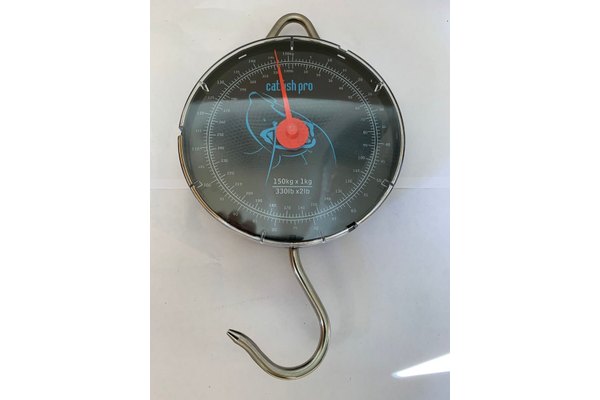
Catfish Pro 330lb Dial Scales
#4 Best Heavy Duty
Most anglers will never need this scale, and that is rather the point of it. A 330lb dial exists for catfish and the sort of fish a 60lb carp scale simply runs out of face for, stopping being any use at all.
Catfish Pro pitch it at travelling catfish anglers and anglers targeting the biggest fish around the world, and that is an honest description of who should be buying. A cat well into three figures is not a fish anybody should be estimating. It is a two-person lift onto a bar, and the scale needs the headroom to answer the question without being asked twice.
The numbers are refreshingly simple: 330lb by 2lb, on a dial carrying the Catfish Pro logo on the face, supplied in a top quality padded scale pouch. That pouch is worth a mention, because a scale living in a car boot across a long drive abroad takes knocks a bank-side set never sees.
The catch is written straight into the specification. Those 2lb graduations mean it is useless for anything small: a 4lb tench would barely trouble the needle, and even a double-figure carp comes out as a rough approximation. This is a specialist instrument that wants a second scale alongside it for every ordinary session, and buying it as an only set would be a genuine mistake.
Best suited to
Anglers travelling for catfish that would bury an ordinary carp scale before the fish was even off the mat.
Pros
- 330lb by 2lb where a carp scale runs out of face
- Supplied in a padded scale pouch
- Aimed squarely at travelling big-fish anglers
Cons
- 2lb graduations are useless on small fish
- Needs a second scale for everyday sessions
Korum Compact Digital Scales
#5 Best for Roving
Some anglers want a scale in a pocket, not in a bag. This ultra compact set fits in the palm of a hand, and Korum aim it squarely at the roving short session angler, which is exactly the job it does: something that tucks in amongst luggage or a spare pocket and only comes out when a fish worth recording turns up.
One touch is the entire operation. The button instantly zeros the scale when it is turned on, so hanging a wet sling and starting from nothing takes a second, which is what matters when a fish is waiting and the next peg is a walk away. The backlit digital display reads easily, the design is ergonomic soft touch, and the weighing apparatus itself is stainless steel.
It weighs up to 66lb, or 30kg, and reads in kilos and grams or pounds and ounces. That dual reading is more useful than it looks when a match sheet wants one unit and the angler thinks in the other. A 2032 coin battery is included, and it ships in its own protective neoprene carry case rather than loose.
The catch is that a 2032 coin cell is not the battery most anglers have rattling about in a tackle box. A spare wants buying deliberately, because nobody is borrowing one off the next peg the way an AA gets borrowed. The 66lb ceiling is a hard limit too, and while it covers virtually every match fish in the country, anyone chasing big carp on their days off will need something else for those trips.
Best suited to
Anglers roving between pegs who need a scale that vanishes into a pocket until the net goes in.
Pros
- Fits in a palm or a spare pocket
- One touch button zeros it instantly
- Reads kg/g and lb/oz up to 66lb
Cons
- 2032 coin cell is awkward to replace bankside
- 66lb ceiling limits it to match-sized fish
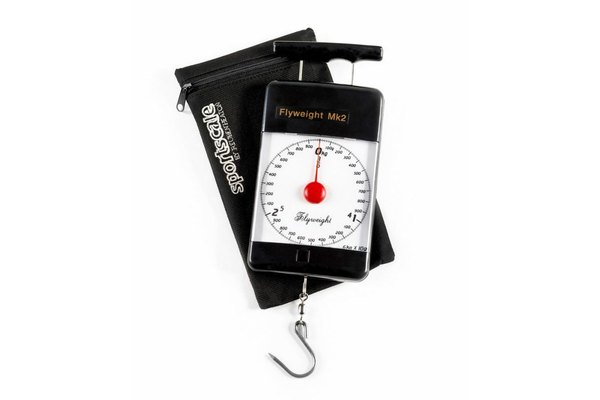
Reuben Heaton MK2 Flyweight Scale
#6 Best Small Scale
195g, and 25mm thick. Those two numbers are the whole argument for the MK2 Flyweight, which Reuben Heaton rate among the slimmest dial scales on the market. It is a truly pocket sized dial scale, and for a river angler walking a few miles with a rod and a bag of odds and ends, that is not a small consideration at all.
What surprised me is the dial itself. The 3000 Series carries a large format face compared to its size, so reading it is not the squint that miniature scales usually turn into. The large tare facility runs to 15% of capacity, meaning a wet net or sling gets zeroed out properly instead of guessed at, and the whole thing comes complete with a dust proof protective pouch.
It arrives in 12lb and 30lb versions, and picking between the two is the real decision to make. The hook and hang point are stainless steel, overload protection is fitted, and Reuben Heaton back it with full after sales servicing and calibration facilities, which means a set that drifts a decade from now still has somewhere to go.
The low capacity is the point and the limit in the same breath. A 12lb or 30lb face reads a chub, a perch or a tench properly precisely because it is not stretching itself across 60lb of range. But hook something over that ceiling and it becomes the wrong tool entirely, however neatly it sits in a pocket. For most anglers this is a second scale, not a first one.
Best suited to
Anglers walking a river bank light, weighing chub, perch and tench rather than carp.
Pros
- Only 195g and just 25mm thick
- Large format dial for such a small scale
- Dust proof pouch and a 15% tare facility
Cons
- Capped at 12lb or 30lb depending on version
- A second scale rather than an only scale
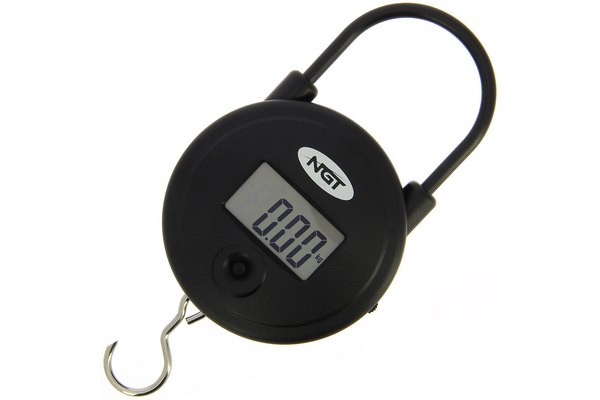
NGT Quickfish Digital Scales 55lb
#7 Best Budget
Not every angler needs a scale to hand down to a grandchild. Some just want an honest number for the odd fish worth remembering, and the Quickfish covers that ground without asking much in return.
The feature I would genuinely use is the one that stores the heaviest weight. A fish that will not sit still sends the reading jumping about, and having the scale hold the top figure takes the argument out of it. A tare weight function zeroes a wet sling before the fish ever goes on.
A large LCD screen displays in lbs and kgs, a battery level indicator flags a fading cell, and an auto 60 second shut off stops it draining itself in the bottom of a bag. The hook stows away, which is one less thing to snag on a bag lining.
Here is the catch, and it is a specific one: it takes a 9v battery, and that battery is not included. Nobody wants to discover that on the bank with a fish in the sling, so one wants buying alongside the scale. A 9v is a less common cell than an AA too, so a spare is worth stashing away.
Best suited to
Anglers wanting an honest number for the occasional good fish without a serious outlay.
Pros
- Stores the heaviest weight automatically
- Tare function and a large LCD screen
- Auto 60 second shut off saves the battery
Cons
- 9v battery is not included in the box
- 55lb ceiling is the lowest of the digital picks
Weigh Slings and Unhooking Mats?
Alongside the best fishing scales, it makes sense to mention 2 other very important accompaniments to go with the weighing scales. A good weigh sling and unhooking mat is vital to ensure we look after the fish we seek and adore.
Although this article isn't about slings or mats, we feel it may be beneficial to you to see the latest 'best sellers' on Amazon below.
Fishing Scales FAQs
Still deciding which scales to trust with a personal best?
These are the questions worth settling first.
Are dial or digital fishing scales better?
It comes down to what an angler minds most. Digital gives a precise figure, switches between pounds and kilos at a press, and reads in finer increments than any dial manages. But it runs on a battery, and a battery always picks the worst possible moment. A dial never goes blank, never needs a cell, and will read the same in twenty years, though it splits the range more coarsely and wants enough light to be read at all. I keep a dial as the set I trust and a digital for the fine reading.
How do I weigh a fish properly?
Wet the sling first, hang the wet sling on the scale, and zero the scale with the sling already on it. Nearly every set in this guide has a tare or zero facility for exactly that reason, the heavy-duty Catfish Pro being the one exception. Weighing a dry sling and subtracting it later is how personal bests get invented by accident, because a soaked sling holds a surprising amount of water. Let the fish settle before taking the reading, keep the scale still rather than swinging, and get the fish back in the water quickly.
What capacity of fishing scale should I buy?
The rule I follow is to buy for the fish being targeted, not the fish being dreamt about. A bigger capacity spreads the same face across a wider range, which is why a 330lb scale reads in 2lb steps while a small pocket scale splits its range far more finely. A 60lb scale covers nearly every carp in the country. Match and river anglers are better served by something smaller and more precise, and only anglers travelling abroad for catfish need to go beyond 60lb.
Do fishing scales need calibrating?
Any scale can drift over years of use, and the simplest check is to hang something of a known weight on it now and again. Reuben Heaton offer after sales servicing and calibration facilities on both of their scales in this guide, which is worth knowing before assuming a drifting set is scrap. Anglers fishing club or match weigh-ins should also check whether the venue asks for scales to be verified, as the rules vary from water to water.
Conclusion
So, with any luck, you have now seen the best ‘weigh’ to go. At the end of the day all you are looking for is ease of stowage, ease of handling, and accuracy. If you can find a scale with these things you’ve got it sussed.
So there you have it, our top choices for the best fishing scales on the market today.
Thanks for reading.
Tight Lines!